Thursday, May 10, 2018

Sankeien Garden (outer garden), Yokohama

This is part two of my trip to Sankeien Garden. (Part one was posted Tuesday).  After passing through the gate between the inner and outer gardens, I took the uphill path to the pagoda.


The Great Kanto Earthquake of 1923 destroyed this villa.


 The Three-Storied Pagoda of Old Tomyoji (important cultural property) was moved to the garden in 1914 from the Tomyoji Temple in Kamo Village, Soraku District in Kyoto. It was built under the Emperor Shomu in 735.  It is the oldest pagoda in the Kanto region.


Haiku Poem by Kyoshi Takahama


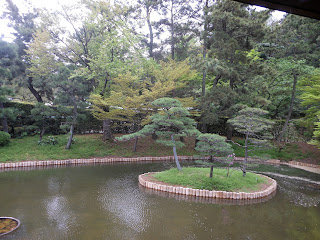
I sat by the pond and ate my lunch.  They want you to know if you lose something in the pond, you can't get it back!


This is a gorgeous place for wedding photos.


Nankosha Shrine and Kanshinbashi Bridge - the shrine originally stood in the Kanshiji temple in Osaka and was believed to have been built in 1334.


 Kotaijingu Shrine


Hatsunejaya and Kangetsuan


Rindoan - consists of a six mat hall and a four mat hall.  Inside the word "Rindo" was written on a board by Sohen Yamada, the founder of the Sohen school of tea ceremony and it is the origin of the name of this arbor.


Old Yanohara House (important cultural property) - this house was originally build in Shokawa Village in Gifu Prefecture around 1750 as the residence of a village headman. It was moved to the garden in 1960 because otherwise it would have been submerged by the construction of a new dam.  The handcrafts inside are from Hida region.


Kankabashi Bridge and the Yokobuean 


Yokobuean - is a country-style tea arbor. It is named after the tragic herione of a famous love story.


Old Tokiji Sanctum (important cultural property) - this sanctum of the Zen Sect style was moved to the garden in 1907, from the compound of the Tokeiji Temple in Kamakura.


Garyobai - the trunk of a Japanese Ume tree looks like a crawling dragon.


Hatsunejaya 


Another wedding photo shoot


This is a Japanese cultural wonderland.  I highly recommend visiting!


Wednesday, May 9, 2018

Work In Progress Wednesday - Vacation Projects

While away on vacation last week, I was able to do a little stitching.  The chicken scratch got most of my attention.  This will be an apron, I think.  


I started the buttonhole photo windows in the snowmen. 


The eyelet fobs didn't make it out of the bag, but they are always a good just-in-case project to take a long.

Tuesday, May 8, 2018

Sankeien Garden (entry and inner garden), Yokohama

I took the train to Yokohama to visit Sankeien Garden. The entry fee is 700 yen, but it is more than worth it! 

(From the website)

Sankeien is a traditional and typical Japanese-style garden designed and landscaped by Sankei Hara (his real name was Tomitaro Hara), a wealthy businessman in the silk trade. 
He reconstructed buildings of historic importance from places such as Kyoto and Kamakura in this garden, which was opend to the public as ”Sankeien”in 1906.
In the garden, whose surface extends to 175000㎡, seventeen old buildings of high historic value are skillfully arranged in harmony with the seasonal changes of the natural scenery.
The Second World War caused great damage, and in 1953 the property was transferred from the Hara family to the care of the Sankeien Hoshokai foundation. Restoration works were carried out, and five years later, Sankeien had nearly recovered its former appearance. 


 The first view at the entrance is the lake and the three tiered pagoda on the hill. There were several of these large maps throughout the grounds so you could find where you were.


The first building on the right is the Former Hara Family Residence, which has been designated a tangible cultural property. The house was built as the primary residence for the Hara family around the 30th year of the Meiji Era. The compound includes a parlor room, living quarters, study, guest room, a Buddhist prayer room and other facilities.


Sankeien Garden is a Japanese-style garden, extending over 180,000 square meters.  It was built and landscaped by Sankei Hara, a wealthy silk trading businessman who was known to be a collector of art.  The garden was opened in 1906.  Historic buildings collected from Kyoto, Kamakura, and other areas are special features of this garden. 


Entry to the Inner Garden


Gomon Gate

I enjoyed Japanese treats and tea.


View from tea area


Old Tensuiji Juto Oido - a juto is a kind of gravestone erected during ancient times during one's lifetime to celebrate one's own or other's longevity. This was originally built in the courtyard of a temple in Kyoto and moved here.


Gekkaden (important cultural property) was built by Ieyasu Tokugawa in the compound of the Fushimi Castle in Kyoto in 1603.  It was used as a guest house where feudal lords stayed when they came to pay their respects to the Shogun.


Kinmokustu - This tea arbor was built in 1918 by Sankei Hara and has a one and three quarter mat tea ceremony room.  Kinmokusu is so named because a handrail from the balcony of the Kinmokaku of Daitokuji Temple in Kyoto was used as the alcove post of the building.


Tenjuin (important cultural property) - The origin of the Tenjuin is a Jizodo (a hall of worship dedicated to Jizo Bosutsu) built in 1651, located at the Shimpeiji Temple in Kamakura. It was transfered to the garden in 1916.


Choshukaku (important cultural property) - was built in 1623 by the third shogun, Iemitsu Tokugawa, in the compound of Nijo Castle in Kyoto, perhaps as one of the garden guildings.  The Choshukaku is important because there are only a few buildings with a structure like this still in existence.  This two storied building was designed on the basis of a balance that avoids symmetry as much as possible.  It was moved to the garden in 1922.


Sekikan (stone coffin) The front was excavated near the Kairyu-0uji Temple in Nara.  The back was excavated near the Hokkeji Temple in Nara.


Shunsoro (important cultural property) - the Shunsoro tea arbor has a three and three quarter mat tea ceremony room.  It was moved to the garden in 1918.


Rengein - includes a tea room with an uncovered wooden floor between two mats, a six mat hall, and an unfloored space.  It was build in 1917 by Sankei Hara.  The column standing at the center of the unfloored space is said to have come from the Hoodo Hall of the Byodoin Temple in Uji, Kyoto.


This is the gate between the inner and outer gardens.


I'll continue with the outer garden another day.


Monday, May 7, 2018

Monday Morning Star Count - Week 52

Can it be true?  Week 52? 

April 22-28  

84, 64, 63, 73, 75, 68, 77


Here I have all 52 weeks, along with four corners.  

April 30, 2017 - April 28, 2018


The bottom right corner is showing the order of how each week is arranged. 


I want to add borders, but I haven't decided on what kind yet. I haven't started a new one for the new year, but I am thinking about it.


Sarah at Sarah Did It! is hosting a link up for those making temperature quilts on Wednesdays. Check it out.


This is my temperature/color (Fahrenheit) scheme: 

100 + Brown 

90-99 Red  

80-89 Orange 

70-79 Yellow  

60-69 Green  

50-59 Blue 

40-49 Purple 

30-39 Pink 

20-29 White 

10-19 Black

Sunday, May 6, 2018

Tokyo Disneyland at 35

Tokyo Disneyland first opened to the public on April 15, 1983.  The park is running a special year long event "Tokyo Disney Resort 35th 'Happiest Celebration'" through March 25, 2019. Tokyo Disneyland and Tokyo Disney Sea, which opened in 2001, have had a combined total of 720 million visitors as of the end of March 2018.  


I've never visited the Tokyo Disney Parks, but many years ago I did visit Disney World in Orlando, Florida on a high school marching band trip.  Many people I know visit Tokyo Disney, some every year.  It's not just children either.  Groups of adult women friends go.  Older couples go.  And of course, families with children go.  


I kind of doubt I will ever go to Tokyo Disney.  From all reports I've heard it is very crowded and very expensive.  Adult one day tickets are 7400 yen, juniors age 12 - 17 are 6400 yen, and children 4 - 11 are 4800 yen.  If you are over 65, your admission is only 6700 yen. The website says that food and drink are not allowed to be brought in, so you must budget for buying food inside the park also.  I don't know how this compares with the Disney Parks in other countries.  Probably it's roughly the same, but I don't know. 


I like this disclaimer at the bottom of one of the website pages:

All photos are concept images.
Entertainment programs are subject to change or cancellation due to inclement weather, etc.
The number of performances each day is also subject to change.
Special merchandise items are available in limited numbers and may sell out.
The contents of the menus may change and some items will only be available while the supply lasts.

On the Rules page it also says:  

  • Members or supporters of organized crime groups will not be admitted.


Have you been to a Disney Park?  What do you think about them? Crowded? Expensive?  Worth it?  The Happiest Place on Earth?

Saturday, May 5, 2018

Handkerchief Butterfly

I have some old, maybe "vintage" handkerchiefs, along with some other newer ones.  I've seen some photos online of quilt blocks and other things made with the handkerchiefs and thought I'd try to do something with mine.  Here is my first attempt at a butterfly, or maybe it is a moth.


Friday, May 4, 2018

Sisters

In Japan, it is heartwarming to see how older siblings help younger siblings.  In the US, I noticed more sibling rivalry than sibling harmony.  Maybe there is just more rivalry and competition overall in the US.


Thursday, May 3, 2018

Yuru-chara, Japanese Mascots

I think every prefecture, region, city, event, and organization in Japan has a cute mascot associated with it.  Every year there is a contest, called the Yuru-chara Grand Prix to decide the cutest mascot of the year.  

YearEntrantsWinner
2010169Hikonyan (Hikone, Shiga)
2011349Kumamon (Kumamoto Prefecture)
2012865Barysan (ja) (Imabari, Ehime)
20131,580Sanomaru (ja) (Sano, Tochigi)
20141,699Gunma-chan (ja) (Gunma Prefecture)
20151,727Shusse Daimyō Ieyasu-kun (ja) (Hamamatsu, Shizuoka)
20161,421Shinjou-kun (ja) (Susaki, Kōchi)
20171,158Unari-kun (ja) (Narita, Chiba)


Many mascots are even famous outside of Japan.  Are there any you like?

Here are a few of my favorites. 

Kumamon from Kumamoto  


Hikonyan from Hikone Castle (nyan is the sound cats make in Japan - like meow in English)


Domo-kun from NHK Television


Meron Kuma (Melon Bear)


Gudetama, the lazy egg


There are quite a few just plain weird ones. 

Nishiko-kun


Marimokkori from Hokkaido


Sento-kun from Nara


Do you recognize any?


Wednesday, May 2, 2018

Work In Progress Wednesday - Vacation Stitching

I always like to bring three projects on a trip, and this trip is no different.  For this trip I chose a new chicken scratch project, 


felt snowman ornaments (pre-cut at home), 


and the eyelet fobs. 


I hope to have progress to show when I return. Do you stitch when you are away from home?

Tuesday, May 1, 2018

Root Beer in Yokohama

I thought Okinawa was the only place to get A&W root beer in Japan, but I was wrong.  You can get it in Yokohama.


I didn't eat at the root beer place, but instead chose to eat Indian food.  They had some interesting looking beer, but I decided on orange juice for my beverage.