Monday, March 5, 2012

Driving in Hokkaido

The first thing you need to know about driving here is that you drive on the other side of the road. That’s enough of a reason for me not to be driving here.  Ted wants to get a car in the spring, when the snow melts.  He had a van and a Japanese drivers license when he lived in Japan before and he’ll be able to take the test and get a license again.  Until then, he has an international driving permit.  Americans cannot drive in Japan with only a US Drivers License.  Drivers are required to have an International Drivers Permit or for residents, a Japanese Drivers License.  If you have a valid US drivers license, you can obtain an International Drivers Permit at the AAA office. You need two passport type photos (that you can have taken at the AAA office) and it costs $15.


Beginning drivers and elderly drivers in Japan are identified with these symbols on their cars, so other drivers know to watch out!


I’ve written before about the small cars with the yellow license plates before.  The K-car or keijidōsha car is a type of small vehicle made to comply with tax and insurance regulations in Japan.


Taxi cabs here have driver controlled doors.  You can’t open and close the doors yourself, the driver has to do it.  The drivers wear white gloves and the seats have lace doily things on them.  The starting fare is 470 yen.

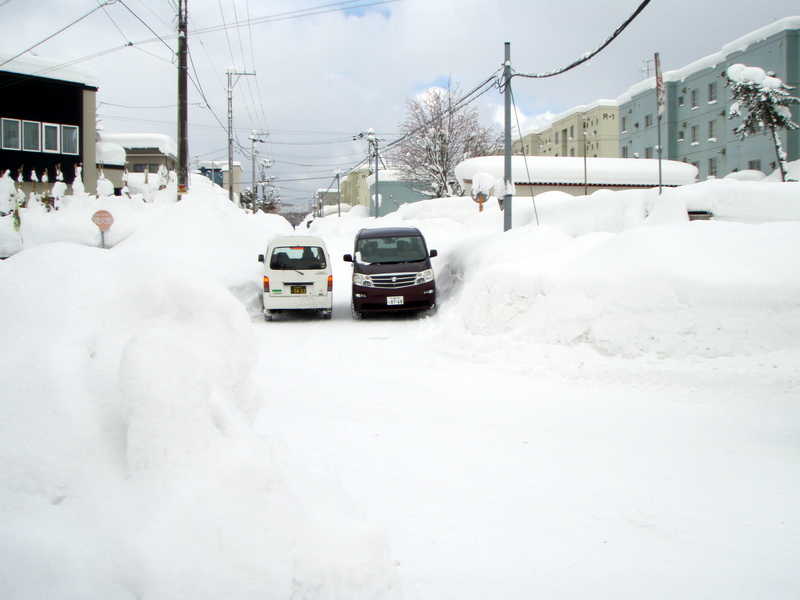
Hokkaido has the highest fatality rates for automobile accidents in Japan because of the snow and winter conditions. Road markings and signs are often covered by the huge amounts of snow.


Sunday, March 4, 2012

Signs in Hokkaido

I see signs everywhere I go and have no idea what they say or mean.


Saturday, March 3, 2012

Hina Matsuri

The Doll’s Festival, or Girl’s Festival, is celebrated on March 3rd.
To celebrate girls growth and good health, dolls dressed in Heian period costumes are displayed on a tiered stand. These dolls represent the Emperor and Empress, their noble court ladies in waiting and ministers.

The custom of displaying dolls began during the Heian period.

 There is a certain order of the tiers of dolls. According to Wikipedia, the top tier hold the Emperor and Emperess dolls, usually in front of a gold folding screen and placed beside green Japanese trees. The traditional arrangement had the male on the right, while modern arrangements had him on the left (from the viewer's perspective).

The second tier holds three court ladies, each holding sake equipment.

The third tier holds five male musicians, each holding a musical instrument except the singer, who holds a fan.

Two ministers may be displayed on the fourth tier: the Minister of the Right ,and the Minister of the Left,. The Minister of the Right is depicted as a young person, while the Minister of the Left is much older. Also, because the dolls are placed in positions relative to each other, the Minister of the Right will be on the viewer's left and the Minister of the Left will be on the viewer's right. Both are sometimes equipped with bows and arrows.

The fifth tier holds three helpers or samurai as the protectors of the Emperor and Empress. Additional platforms can hold miniature furniture, tools, etc.
             
Families generally start to display the dolls in February and take them down immediately after the festival. Superstition says that leaving the dolls past March 4 will result in a late marriage for the daughter.

Here are some photos of displays I saw at the department store in the mall. I wonder if you can start small and add to it, spreading the cost over several years? Another question I have is whether girls are allowed to play with the dolls?




Friday, March 2, 2012

Aikido

Aikido is one of the newer martial arts, starting in Japan in the twentieth century, and is a method of self defense utilizing throws and joint holds.   Common movements in Aikido are based on those of Japanese swordsmanship. Aikido translates as “the way of harmonious spirit”. Aikido was founded by Morihei Ueshiba, who studied jujitsu before developing Aikido in the first quarter of the 20th Century. After World War II, Aikido expanded internationally, being introduced in Hawaii and France. Today the art is flourishing in the United States, Europe, Brazil, and more recently in Australia and Southeast Asia.


Ted began studying Aikido in1989 at Osaka University of Foreign Studies and continued after moving to Tokyo.  He earned his first degree black belt while in Akita and developed a Physical Education class that he taught at what is now known as Akita International University.  He later earned his second degree before returning to the US in 1995.


After moving to Hokkaido in October, he joined the local dojo and began practicing again. His sensei here is Takeda Sensei, a fifth degree black belt who is 68 years old.


Takeda Sensei at Bonenkai

Thursday, March 1, 2012

Vending Machines in Hokkaido

There are a lot of outdoor vending machines with drinks and cigarettes.  Some of the drink machines have both hot and cold drinks, in the same machine. I don’t know how they work when it is so cold out all the time to keep the cold beverages from freezing and the coffee in cans hot.


There aren’t many choices when it comes to carbonated beverages – usually just coca-cola, sometimes coke zero. I've also seen Fanta.


There is one beverage called Pocari Sweat.  Why would you want to drink something called Sweat?


You can get soup from the vending machine.  I haven't tried it.


Cigarettes are also sold in machines.  I don’t know if there is a minimum smoking age.  410 – 470 yen seems expensive for a pack of cigarettes, but maybe they are just as expensive in the US.


These beer machines were at a ski area.  I haven’t seen any on the street.  I guess people are just on their honor not to buy beer unless they are of legal age.