Monday, June 10, 2013

Sapporo "Yosakoi Souran" Matsuri 2013

Last year, Ted and I attended this festival together.  This weekend, he was on a camping trip with his outdoor skills class, so I was on my own.  As I was walking to the bus stop, a car passed me and the driver waved. People often wave to me and I don’t always know who they are, so I waved and continued walking.  I saw the car pull over and recognized the driver as a woman I know.  She is active in the International Exchange Society and is the wife of a University coach and professor. She asked where I was going as and as it turned out she was going to Sapporo to visit her mother and invited me to ride with her.  Ted is busy with his classes and field trips, but as a foreign instructor he doesn’t have near the obligations that the Japanese professors have.  In addition to the classes and advising and meetings and research and publishing and conferences, many are also coaches with practices and competitions. Her husband was gone for a sports competition and she referred to herself as a soccer widow. The ride with her was much more pleasant than riding the bus and I enjoyed talking with her.

This is the festival’s description online:
Every year Sapporo holds a "Yosakoi" dance festival, known as the "Yosakoi Souran Matsuri".
The original Yosakoi festival began in the city of Kōchi, down South in the Shikoku region in 1954. Since then, it has become popular throughout Japan, with many Yosakoi festivals held in a number of prefectures, and the Sapporo Yosakoi Souran Matsuri, which began in 1992, is one of the most well-known Yosaki festivals in the country.

Many Yosakoi dance teams from all over Hokkaido, as well as from other areas of Japan,  perform their routines over the 5 days over 19 different venues, either on stage or as a parade through the city. There is judging and contests for some dance performances.


I like seeing dance of all kinds, but my main purpose this day was to see one of my university students and his group dance. I arrived at the venue (in front of the train station) about half an hour before his group was scheduled to perform to make sure I wouldn’t miss him. His group is large and there were often dancers in front of him, so I did not get good photos, but I was happy I was able to see him.


I saw several performances before his.  The dancers are of all ages and the groups of various sizes.  There are often one or two group members on a stage behind the other dancers, singing or calling out syllables, maybe directions? I couldn’t tell what they were saying.


The colorful costumes are very interesting!  There are often several costume “changes” within a few minutes as the dancers’ tops become skirts or sleeves turn inside out or sometimes outer costumes are taken off and thrown to the side of the stage.

The first three pictures are the same group


This picture and the next are the same group


After leaving the venue at the train station, I went to Odori Park and watched one the parades from the street side bleachers. There are two parade routes with groups back to back the entire time.


As with all festivals, there were many choices of food vendors. I’m never sure what the food for sale is, so I ate the lunch I brought and only bought a drink.

I walked around watching the dancers at other venues and the people in general. The lilacs are in bloom and smell heavenly.


Even though I was wearing sunglasses, a hat, and sunscreen, I knew I needed to be mindful of the time I was in the sun, so I headed for home mid-afternoon.  It was another good day in Hokkaido. 

Sunday, June 9, 2013

Has the Neko Chan Returned?

Last summer we found a cute little cat, or maybe I should say it found us.  Ted built a little house and we fed and played with it.  One day it just disappeared and we never saw the Neko Chan again.

One of our friends saw a black and white cat at the fence between our apartment and the university and sent this picture by email, asking if this kitty was a friend of ours. 

 
Neko Chan, is that you?

Could it be the Neko Chan?  I was on my way out the door to Sapporo for Japanese class and didn't have time to investigate, but Ted went out and looked around, but could find hide nor hair of the kitty. Our friend said the kitty looked well fed but dirty.  We’ll all continue to watch out to see if this kitty is our old friend.

Cats teach Japanese
There are a lot of cute and funny cat videos on the internet.  I’m especially fond of Maru on YouTube.  I don’t usually share them, but this article on Rocket News 24 is educational, as well as cute and funny.  If I hadn’t seen this, I wouldn’t have believed it – you can learn Japanese with cat videos.

Saturday, June 8, 2013

The Beaded Necklace Class

I have made several little bead and cross stitch on perforated paper pocket necklaces over the years.  One that I wore was admired by one of my Japanese teachers. I told her it wasn’t difficult to make and that I could teach her. I no longer had the directions for the one I wore and here in Japan, I couldn’t find the size beads it used anyway, so I made up a new one. I charted it out on Microsoft Excel as I went along.  Four other teachers were also interested (even though they hadn’t seen the necklace), so I made up five kits of different colors with the necessary beads and threads and of course, the perforated paper.


I didn’t know if any of them had stitched before and was afraid they wouldn’t like it. After Japanese class this week, I got out the example and the kits and was relieved that they all seemed to like it. I tried to tell them that the first step, with all the counting, was the most difficult and that it would be easier after the first color of thread was stitched.  A few of them found threading the needle difficult, so I attempted to explain and demonstrate my trick of “needling the thread” by pinching the thread over the needle between the index finger and thumb of my left hand, then pulling out the needle and pushing it onto the thread between my pinched finger and thumb, without even seeing the thread.  It works nearly every time. Maybe I can learn how to say pinch in Japanese before next week’s session.


Friday, June 7, 2013

TAST 69 - Buttonholed Double Chain Stitch


This week's Take a Stitch Tuesday is the Buttonholed Double Chain Stitch.

I was really busy this week and the stitch looked difficult, so I didn’t attempt it on Tuesday, like I usually do.  It wasn’t as difficult as it looked, although I do need practice on maintaining a straight line! As Sharon warned, it was a bit wobbly at first, but behaves after getting a few stitches in place.  My first attempt was the red #5 perle cotton; next, the blue #8 perle cotton; and finally, the yellow soy luster.  I think the fatter thread shows the stitch definition better, although if the stitches with the thinner threads were smaller, they might look better. In all three threads, the stitch would look better if it were straighter.  I like this one and will use it again.

Thursday, June 6, 2013

The Aikido Party

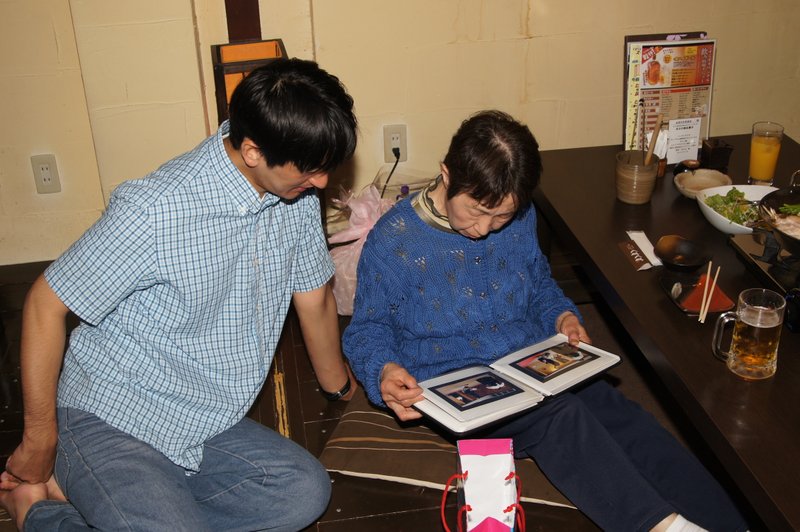
Ted’s Aikido group held a party at a local restaurant to celebrate the 70th birthday of the fifth degree black belt sensei, to celebrate the earning of the first degree black belt by one in the group, and as a goodbye to another sensei (fourth degree black belt) who is moving to another country with his job.  Ted had taken photos at a recent practice and we had the photos printed at Cosco.  We put together little albums for the three and Ted had extra group photos made for the others. People are always happy to get the photos Ted takes.


It was good to have the party for all three at once.  While everyone is sad that one person is leaving, they were happy to celebrate with the other two.


Wednesday, June 5, 2013

One Day Ornament - The Mitten

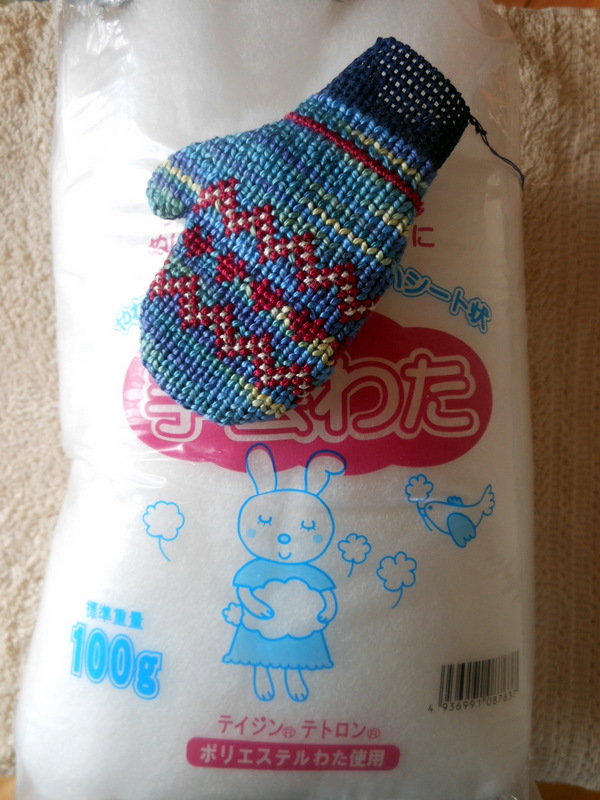
This is a design by Sue Stehle of Sekas & Co., stitched on navy colored 14 count Zweigart Lincoln with Watercolors and #8 perle cotton.  The backing fabric is a blue cotton from my stash.


I put right sides together and stitched around the mitten, using regular navy blue sewing thread, leaving the top open.

I turned the mitten right side out and stuffed it.

 I made a hanger by braiding three strands of the perle cotton and stitched the top closed. Three inches tall and finished in a day.

Tuesday, June 4, 2013

From the Archives

Ted and I have known each other for a long time.  He recently came across this photo he took of me in March 1985.  We had hiked to Harper's Creek in western North Carolina. It’s hard to believe that this photograph is older than I was when the photo was taken. I couldn't have guessed back then that one day we'd be married and living in Hokkaido!

Sunday, June 2, 2013

Chihiro Iwasaki Exhibit

The Museum of Modern Art in Sapporo hosted a special exhibit of the art work of Chihiro Iwasaki for a little over a month. Chihiro Iwasaki is best known for her water color illustrations of flowers and children, with a theme of "the happiness of children and peace."

I hang out at the museum for a couple of hours each week between my Japanese class and my English classes and I was surprised by how crazy busy the museum has been since this exhibit opened. I think this must be the equivalent of a Norman Rockwell exhibit in the US, as far as how well known and liked the artist still is.  Each week I thought I would see the exhibit the next week when it was less busy, but it never did get less busy.  Finally, the last week, I paid the 1200 yen admission to see it before it closed.

Chihiro Iwasaki was born in 1918 and moved to Tokyo with her family the following year, where they lived until 1945. As a child she loved to draw, and began studying art at age 14.  She graduated high school in 1936 and was married in 1939 to a man through an arrangement her parents made.  She was widowed in 1941 when her husband committed suicide.  After the end of World War II she joined the Japanese Communist Party in an effort to end war and stop the suffering of children.

She became a writer and illustrator and published her first children’s work in 1950, the year she remarried.  They had one son born in 1951. She went on to publish many more children’s works and win many awards.  In 1974, she died at age 55 of liver cancer.

Photographs were not allowed at the museum, of course. I couldn’t read the descriptions on her work, but the titles were in English and I could see the year. Most of the works in the exhibit were in watercolor.  The early pieces, from the 50’s through early 60’s I’d say, were more detailed. The later works were softer and “dreamier”, many very simple. The museum had a reading area with the children’s books, and other books could be found along side the large pictures  that were featured in the books. One glass case had a few of her dresses and hats and personal items. Another part of the exhibit explained a month long trip to Europe she took, along with a map showing where she traveled and a few pictures, her passport and some post cards.  If I could read kanji, I’d know more, but since I don’t, that’s all I could get out of the trip display. There was also a time line of her life on one wall.  I looked at the years and the photos.

Although it’s not the type of art I’m particularly interested in, I am glad I saw the exhibit, more from a Japanese culture perspective than for the art itself. The museum's website shows a few of her works here if you are interested.


Saturday, June 1, 2013

June Calendar


This is Ted’s birthday month and it’s our tradition to be celebrating the entire month. He has a lot of class field trips (camping, canoeing, rock climbing, and outdoor photography), plus a professional conference in June, so we'll have to make the most of the time he’s not working.